


- Details
- Hits: 7676
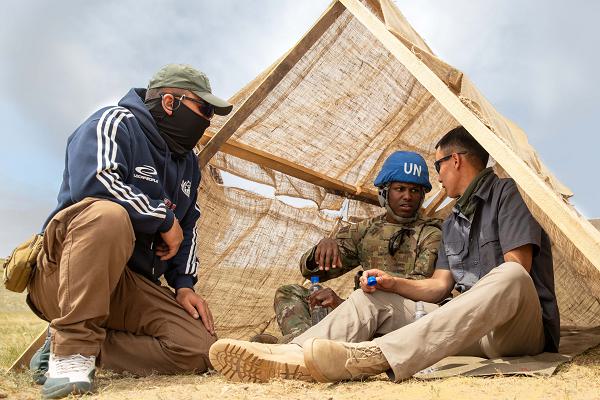
Five Hills Training Area, Mongolia. (June 16, 2025): They are descendants of a warrior culture that conquered the known world in 1223 A.D. In this photo by Army Staff Sergeant Christopher Stelter, 1st Lieutenant Davonta Vaughn and interpreter Fa Ganbaatar speak to Mongolian Armed Forces Staff Sgt. Dadaasuren Tumen Ulzii during foot patrol training. The Americans are participating in Khaan Quest, an annual exercise designed to promote regional peace and security. The U.S. is working with Mongolia to foster stronger democratic institutions, including supporting citizen participation, and promoting a more market-driven economy.
The warrior spirit of the people of Mongolia is legendary. In 1206, Genghis Khan was able to unite the various Mongol tribes into a fighting force that terrorized their enemies. Today, the Mongolian armed forces consist of three branches, a ground force, a construction and engineering unit, and special forces. The current ground component has roughly five hundred tanks, 650 infantry fighting vehicles, and over five hundred mobile air defense systems. Most of them are old Soviet Union models designed between the late 1950s to early 1980s. Instead of heavy combat, its mission is focused on peacekeeping operations and humanitarian assistance.
- Details
- Hits: 7405
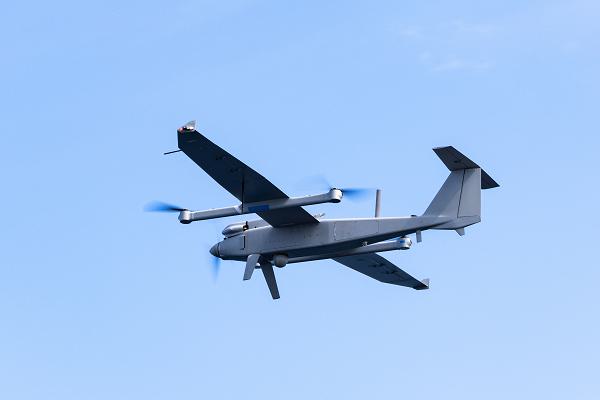
Atlantic Ocean. (June 13, 2025): "If you know the enemy and know yourself, you need not fear the result of a hundred battles." Sun Tzu, The Art of War. Today’s Marines have a new tool to track enemy movements at sea in real time and in all weather conditions. In this photo by Sergeant Nathan Mitchell, a Jump 20 Unmanned Aerial System (UAS) flies a reconnaissance mission while underway with the Amphibious Ready Group, Marine Expeditionary Unit. A product of AeroVironment, the Jump 20 is an artificial intelligence-equipped autonomous aircraft designed specifically for maritime operations.
The plane can take off and land vertically and is equipped with advanced multi-sensor intelligence, surveillance, and reconnaissance capabilities. Designed to be operated at sea, the Jump 20 uses artificial intelligence to precisely land on moving vessels. Measuring nineteen feet long with a nine-foot wingspan, the Jump 20 can be set up and operational in less than 60 minutes without the need for launch or recovery equipment. It can loiter up to thirteen hours above a target and has a range of 115 miles. Powered by a heavy fuel engine for enhanced operational flexibility, the Jump 20 can cruise at a speed of fifty-eight miles per hour at a maximum altitude of 17,000 feet.
- Details
- Hits: 7441
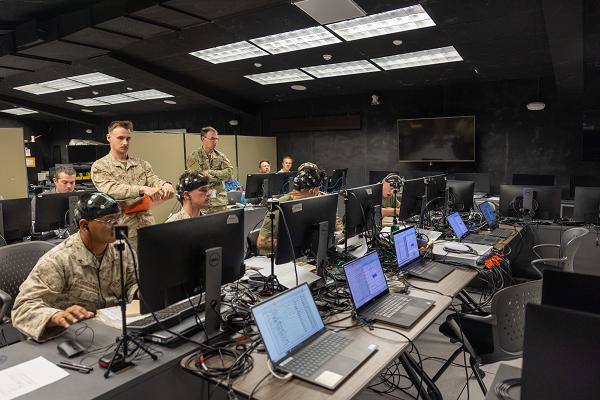
Twentynine Palms, California. (Jun 18, 2025): No surprises. These are the watchwords for Marine commanders as they prepare their troops for combat. One of the key tools for planning successful operations is the Marine Corps’ Battle Simulation Center. In this photo by Corporal Anna Higman, Marines with the 3rd Light Armored Reconnaissance Battalion, 1st Marine Division, I Marine Expeditionary Force, participate in simulated training at the Marine Corps Air Ground Combat Center.
The Marines are collaborating with the Defense Advanced Research Project Agency (DARPA) to study and improve Marine Corps training using advanced technology. DARPA is famous for developing game-changing technological advances like the Internet, GPS, drones, and stealth aircraft. The agency also funds research studies that keep the U.S. military on the forefront of modern warfare.
- Details
- Hits: 7402
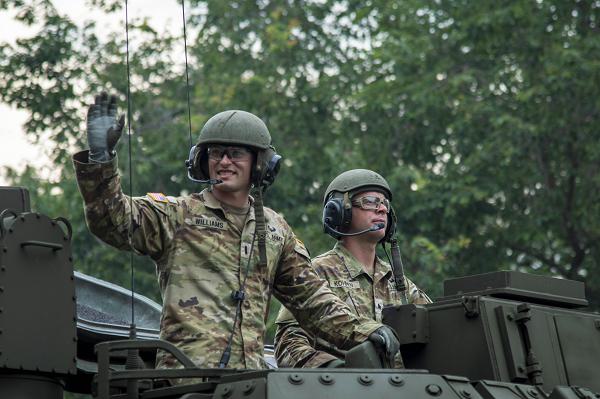
Washington, D.C. (June 14, 2025): In this photo by Staff Sergeant Oscar Toscano, Soldiers participate in the Army's 250th Birthday Parade that included troops in historical and modern uniforms marching alongside equipment and vehicles from key eras of Army history.
Finding themselves without a force to fight the British, the American Army was established on June 14, 1775. under the command of George Washington. Prior to the creation of a professional Army, the colonists relied on local civilian soldiers, or militia, which were untrained and often ineffective. In 1784, the first full regiment of Regular Army infantry, the 3rd Infantry Division, was formed. The unit today is known as the “Old Guard” and remains the oldest branch of the U.S. military. The Army overcame numerous military setbacks, a lack of equipment, and dwindling supplies to defeat the British Army, the most powerful military force in the world at the time.
- Details
- Hits: 7347
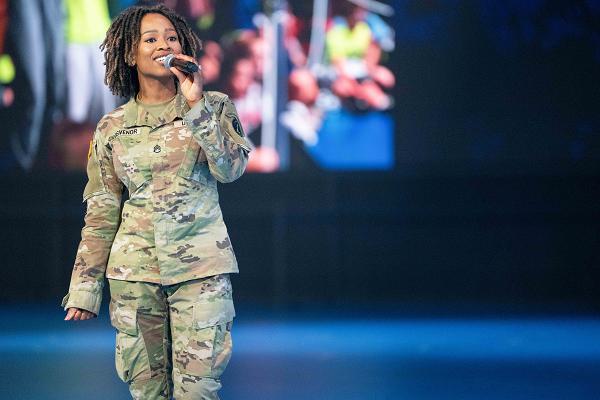
Joint Base Myer-Henderson Hall, Virginia. (May 28, 2025): She has a voice so rich and powerful one would think it was heaven sent. In this photo by Specialist Joseph Martin, Army Staff Sergeant Imani Grosvenor sings during a Twilight Tattoo performance. SSgt. Grosvenor sings Soprano for the U.S. Army Chorus, the vocal counterpart of The United States Army Band’s “Pershing’s Own.” Founded in 1956, the Chorus has a reputation for musical excellence for its inspirational performances for military and civilian audiences.
A native of Harlem, New York, Grosvenor graduated from the University of Michigan and joined the band in 2022. She is an accomplished opera performer who has worked in music theater and concerts in Europe and America. Her notable performances include Mary (Highway1), Emmie (Albert Herring), Laetitia (The Old Maid & the Thief), Patience (Patience), Sarah (Ragtime), and Rapunzel (Into the Woods).
The U.S. Army, and the American people, are fortunate to have such an angelic voice representing this great nation.
- Details
- Hits: 8289
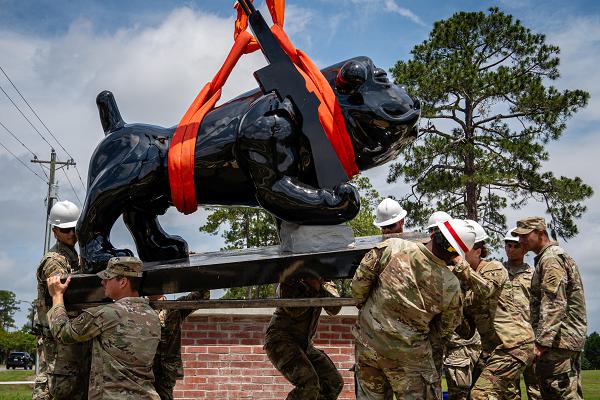
Fort Stewart, Georgia. (June 12, 2025): Amongst themselves, Army Soldiers call each other “Dogface” as a term of endearment. The nickname can be seen as an insult, however, when used by other branches of the military. In this photo by Specialist Luciano Alcala, Soldiers install a support frame for a new Rocky the Bulldog statue at Fort Stewart. Rocky is the 3rd Infantry Division's mascot and serves as a tribute to the enduring legacy of the Dogface Soldiers.
"Dogface soldiers" is a nickname given to Army infantrymen during World War II and is most identified with the 3rd Infantry Division, known as the "Marne Division".
The term first appeared in print at least as early as 1935 due to Soldiers wearing “dog tags” and sleeping in “pup” tents. Still others claim the troops came up with the moniker explaining “an infantrymen lives a dog’s life, when they want us, they whistle, and we obey.”